
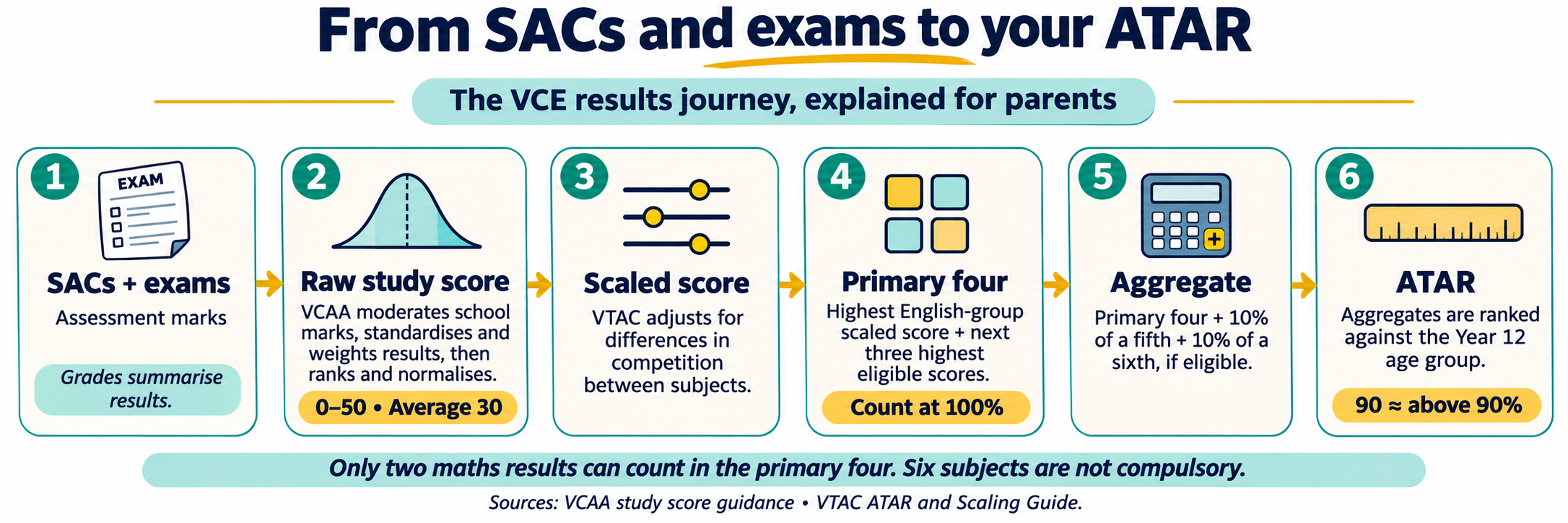
Your child gets 80% on a SAC, hopes for a study score of 35, and talks about needing an ATAR of 90. How do those numbers connect?
They measure different things. The SAC mark is an assessment result. The study score shows performance within a subject. The ATAR ranks overall achievement against the Year 12 age group.
It starts with SACs and exams
SACs—School-assessed Coursework—are assessed tasks completed during the year. Together with exams and any other required assessments, they provide the marks used to calculate a study score.
Schools set different SACs, so an 80% at one school may represent different achievement from an 80% elsewhere. VCAA uses statistical moderation to make school assessment marks comparable, drawing on the school group’s external assessment results. Students retain their order within their school assessment group. Source: VCAA
VCAA then compares each assessment result with statewide performance and combines the results using the subject’s weightings. In English, these are:
- 25% Unit 3 coursework
- 25% Unit 4 coursework
- 50% examination
The combined results are ranked within the subject and converted to a scale from 0 to 50, centred on 30. This conversion is called normalisation. It produces the raw study score.
That’s why 80% does not automatically become a study score of 40. Performance compared with other students matters. Letter grades such as A and B+ summarise results; the calculation uses the underlying marks. Source: VCAA
Then comes scaling
VTAC adjusts raw study scores to account for differences in competition between subjects. The resulting scaled scores are the numbers used in the ATAR calculation. Source: VTAC
How do five or six subjects count?
Students may complete five or six scored Unit 3–4 subjects across their VCE program. A subject completed in Year 11 can count alongside subjects completed in Year 12. Six subjects are not compulsory for an ATAR. Source: VCE Results and ATAR Service
Four eligible scaled scores count in full. These are called the primary four:
- The highest scaled score from the English group: English, EAL, English Language or Literature.
- The next three highest eligible scaled scores.
An English-group result must be included, even when other results are higher.
A fifth and sixth eligible scored subject each contribute 10% of their scaled score. Adding these contributions gives the aggregate. Source: VTAC
Three examples make this easier to follow. All scores below are hypothetical and already scaled.
Emma completes five subjects
| Subject | Scaled score | Contribution |
|---|---|---|
| English | 30 | 30 |
| Mathematical Methods | 35 | 35 |
| Biology | 34 | 34 |
| History: Revolutions | 32 | 32 |
| Psychology | 28 | 2.8 |
| Aggregate | 133.8 |
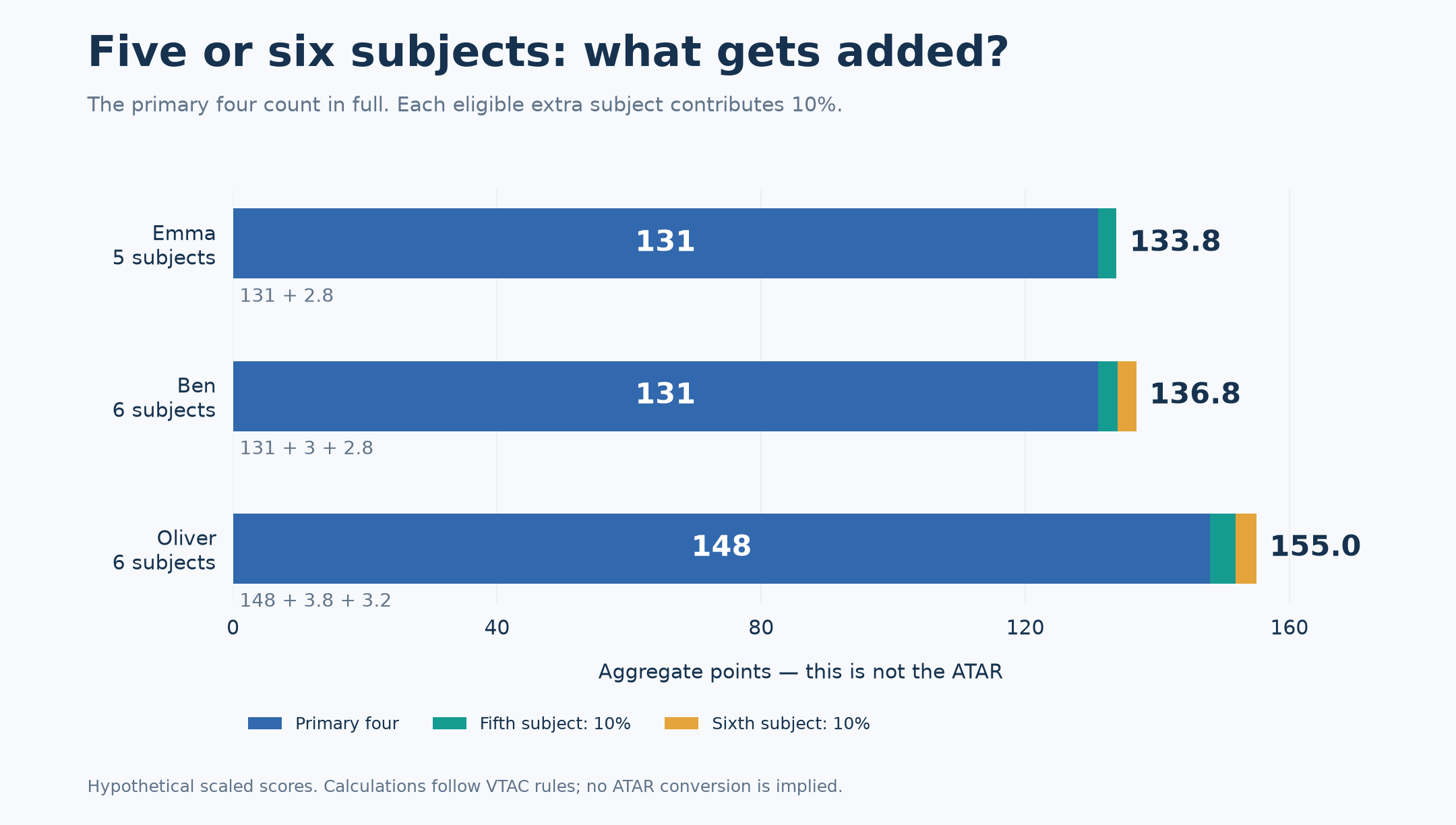
Emma’s primary four contribute 131 points. Psychology adds 2.8.
English counts in full, even though three of her other results are higher.
Ben completes six subjects
Ben achieves the same results as Emma, plus a scaled score of 30 in Business Management.
His primary four still contribute 131. Business Management adds 3 points, and Psychology adds 2.8:
131 + 3 + 2.8 = 136.8 aggregate points.
With his other results unchanged, the additional subject contributes three aggregate points. It does not add three ATAR points.
A subject studied sixth can also enter the primary four if its result is high enough and the combination is eligible.
Oliver completes six subjects, including three maths
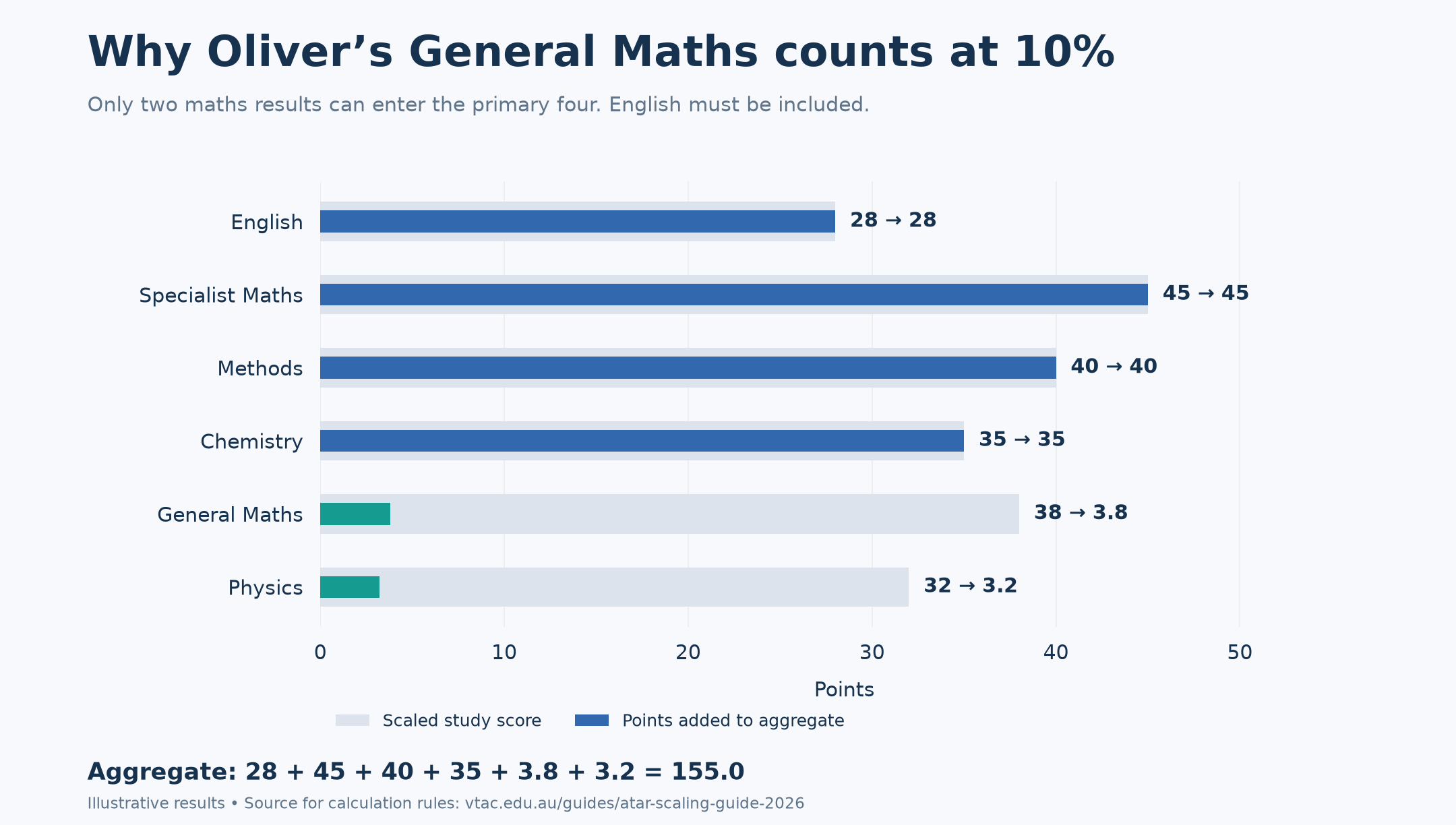
Oliver’s calculation has an extra restriction: only two maths results can count in the primary four. Source: VTAC
| Subject | Scaled score | Contribution |
|---|---|---|
| English | 28 | 28 |
| Specialist Mathematics | 45 | 45 |
| Mathematical Methods | 40 | 40 |
| Chemistry | 35 | 35 |
| General Mathematics | 38 | 3.8 |
| Physics | 32 | 3.2 |
| Aggregate | 155.0 |
Although General Mathematics is higher than Chemistry, it contributes only 10%. Specialist and Methods already occupy the two maths places in Oliver’s primary four.
How does the total become an ATAR?
VTAC puts students’ aggregates in order and converts them into ranks, accounting for the wider Year 12 age group.
An ATAR of 90.00 means achievement above approximately 90% of that age group. It does not mean an average exam mark of 90%.
The conversion changes each year, so an aggregate of 155 does not always produce the same ATAR. Source: VTAC
For parents helping with subject choices, start with your child’s strengths, interests and possible university prerequisites. Consider whether a sixth subject fits comfortably into their workload, and give English regular attention throughout the year.
Once subjects are underway, useful support is often practical: a manageable study routine, time to act on teacher feedback, and help with difficult topics before the gaps grow.