
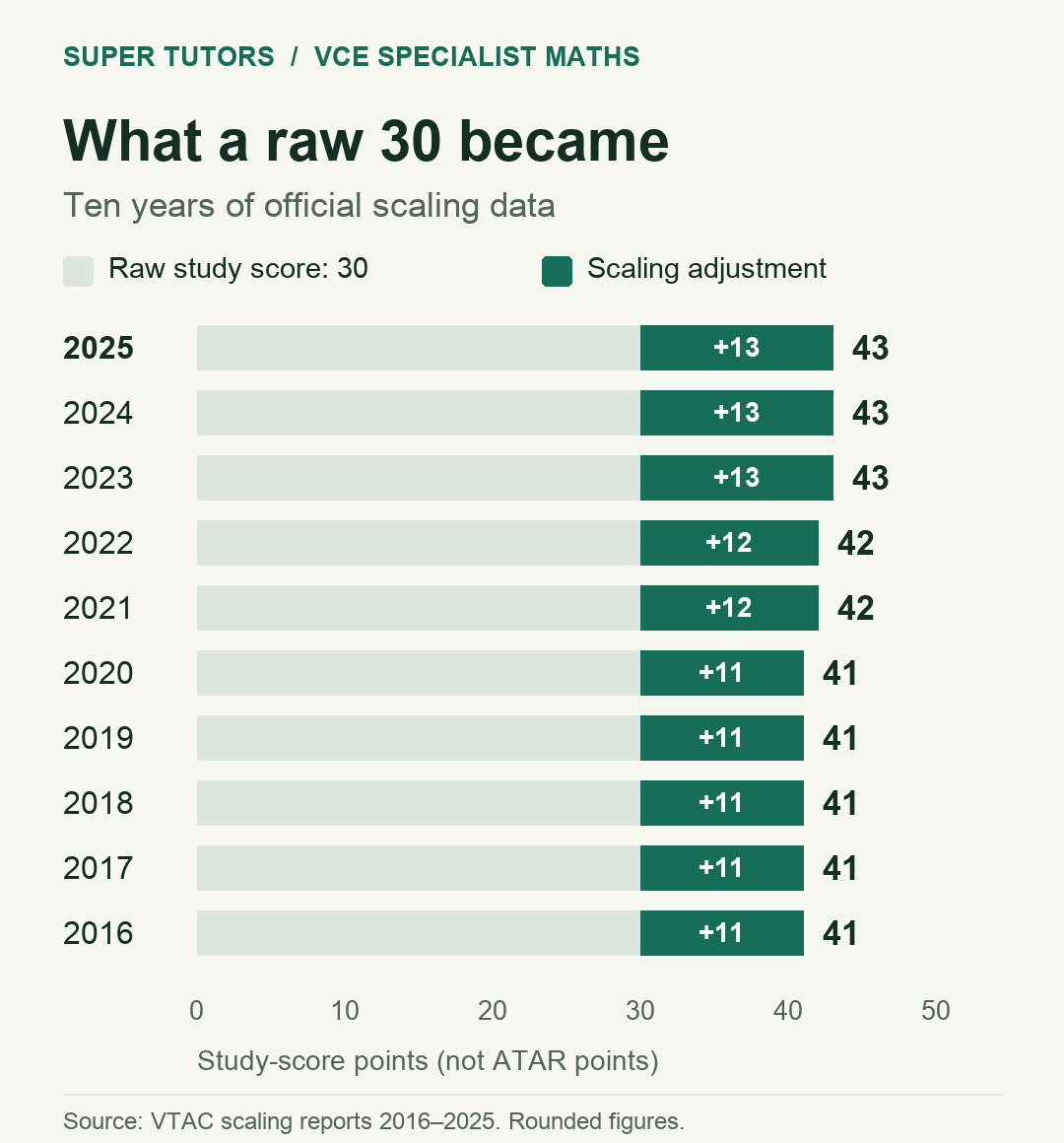
A raw study score of 30 in VCE Specialist Mathematics scaled to approximately 43 in 2025. A raw 35 became approximately 48.
Those numbers can make Specialist Maths attractive, but understanding how students reach their raw study score is just as important as understanding scaling. Here is how SACs, Paper 1 and Paper 2 fit together, and what 10 years of official data tells parents and students.
Who calculates your result?
VCAA calculates your raw study score using your coursework and examination results. VTAC then scales that study score for use in calculating your ATAR.
Your raw study score shows how you performed compared with other students taking Specialist Maths. It is a score out of 50, rather than an exam percentage. A study score of 30 does not mean you scored 30% on your exams. VCAA study-score explanation.
The three parts of your Specialist Maths result
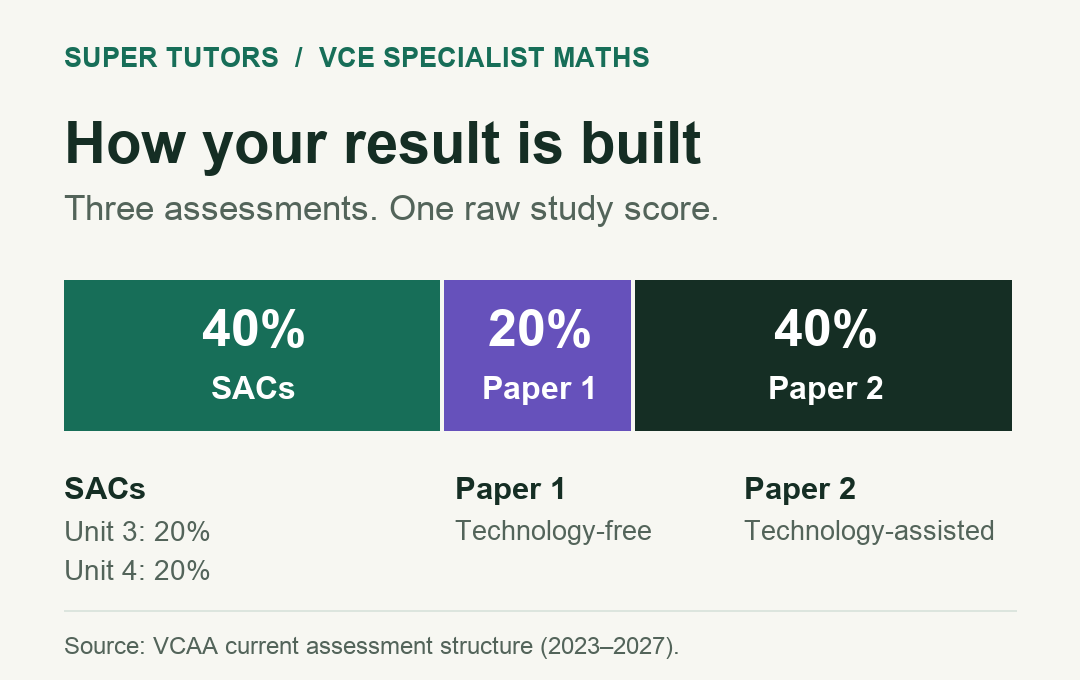
Under the current assessment structure, your result comes from three graded assessments.
| Assessment | What it includes | Weighting |
|---|---|---|
| SACs — GA1 | Unit 3 and Unit 4 coursework, worth 20% each | 40% |
| Paper 1 — GA2 | Technology-free examination; 40 marks; 1 hour writing time | 20% |
| Paper 2 — GA3 | Technology-assisted examination; 80 marks; 2 hours writing time | 40% |
Both examinations also include 15 minutes of reading time. Together, the exams contribute 60% of the assessment weighting. SACs deserve consistent attention throughout the year, while preparation for both examination formats remains essential. VCAA assessment summary; examination specifications.
What do actual SAC and exam results look like?
VCAA's 2025 grade distributions provide useful context.
| Assessment | State average as a percentage | A+ grade started at |
|---|---|---|
| Moderated SACs | 71.4% | 91% |
| Paper 1 | 59.8% | 93.8% |
| Paper 2 | 65.8% | 94.4% |
Percentages are calculated from VCAA's published means and grade boundaries. Its exam distribution tables report totals out of 80 and 160, equivalent to the papers' 40- and 80-mark scales. VCAA 2025 Specialist Mathematics grade distributions.
For parents, the perspective matters: around 60% on Paper 1 was close to the statewide average in 2025. A percentage on a challenging Specialist Maths paper needs context. These are one year's benchmarks; future exam averages and grade boundaries can change.
Why averaging your percentages does not give your study score
The 40%–20%–40% weighting is only part of the calculation. VCAA moderates SAC results to make assessments from different schools comparable, preserving students' rank order within their school moderation group. It then standardises each assessment score, applies the weightings and ranks the combined results to produce study scores.
This means a school SAC average of 80% does not automatically become a final moderated SAC score of 80%. There is also no fixed set of SAC and exam percentages that guarantees a raw study score of 30, 35 or 40. VCAA moderation explanation; score calculation.
Specialist Maths scaling from 2025 to 2016
As at November 2026, the latest complete 10-year period is 2016–2025. The newest year appears first. Each column starts with a raw study score; the figures show what it became after scaling. Each year links to its official VTAC report.
| Year | Raw 20 | Raw 25 | Raw 30 | Raw 35 | Raw 40 | Raw 45 | Raw 50 |
|---|---|---|---|---|---|---|---|
| 2025 | 29 | 36 | 43 | 48 | 51 | 54 | 55 |
| 2024 | 28 | 36 | 43 | 48 | 52 | 54 | 55 |
| 2023 | 29 | 37 | 43 | 48 | 52 | 54 | 55 |
| 2022 | 28 | 36 | 42 | 47 | 51 | 54 | 55 |
| 2021 | 28 | 35 | 42 | 47 | 51 | 54 | 55 |
| 2020 | 27 | 35 | 41 | 47 | 51 | 54 | 55 |
| 2019 | 27 | 34 | 41 | 47 | 51 | 54 | 55 |
| 2018 | 27 | 35 | 41 | 47 | 51 | 53 | 55 |
| 2017 | 27 | 35 | 41 | 47 | 51 | 53 | 55 |
| 2016 | 27 | 34 | 41 | 46 | 50 | 53 | 55 |
VTAC publishes these figures rounded to the nearest whole number. Actual ATAR calculations use scaled scores to two decimal places. Across the decade, a raw 30 scaled to approximately 41–43, while a raw 35 scaled to approximately 46–48. Specialist Maths scaled upwards at every score shown in every year reviewed. Historical figures do not guarantee future scaling.
Why does Specialist Maths scale up?
Scaling accounts for differences in the level of competition between subjects, using students' performance across their other studies. Mathematics also has an additional rule: VTAC scales maths subjects against one another and against all studies, then uses the higher result. VTAC scaling guide.
The adjustment is not a fixed bonus. In 2025, a raw 20 became approximately 29, a raw 30 became 43, and a raw 40 became 51. Gaining 13 study-score points does not mean gaining 13 ATAR points: your ATAR depends on your combined eligible results. 2025 scaling report; ATAR guide.
Should students choose Specialist Maths for the scaling?
The historical scaling is strong, but it cannot guarantee a higher ATAR. VTAC advises students to consider their interests and strengths when choosing subjects. VTAC subject-choice guidance.
For families, a useful conversation starts with the student's enjoyment of maths, confidence with algebra, willingness to practise and overall workload.
For students already taking Specialist Maths, the data offers perspective: a demanding exam result can still lead to a valuable scaled score. Keep working across SACs and both papers, and ask your teacher to help interpret your progress before judging it by a percentage alone.
Explore Specialist Maths tutoring at Super Tutors or contact us to discuss support with coursework and exam preparation.