
Starting Year 7 in 2027 means new subjects, teachers, classrooms and friendships. Your child does not need to finish a Year 7 textbook before the first day. A useful summer goal is to help them manage a simple routine, explain their thinking and know how to ask for help.
This checklist is for families moving from Year 6 into secondary school. Choose the activities that fit your child, leave plenty of room for holidays, and use the new school's instructions as your starting point.
1. Make the first school day feel familiar
Read the school's orientation information together. Practise the journey, including where to meet after school and what to do if transport is delayed. Find the first-day meeting point, check uniform and equipment requirements, and save the school's contact details. Confirm your child's actual starting date with the school.
Ask, “What are you looking forward to?” and “What would you like to find out?” Write down the questions you cannot answer. A transition coordinator can clarify practical concerns such as lockers, changing classrooms or finding the right teacher. The Victorian Department of Education's transition guidance describes support across the move to secondary school; your child's school can explain its own arrangements.
2. Build independence with one repeatable routine
Practise a short “check, pack, ask” routine: check tomorrow's timetable, pack the required materials, and note anything that needs a teacher's answer. Let your child complete the steps before you check together. A paper checklist can work just as well as an app.
- Timetable: find the day, subject, room and teacher.
- Equipment: prepare books, charged school device if required, water and any activity gear.
- Homework: record the task and due date in one place.
- Help: choose one question to ask when something is unclear.
Try it with a family outing first. Ask your child to read the plan, calculate the departure time and pack what they need. If a step is missed, adjust the checklist together.
3. Keep the learning routine small enough to use
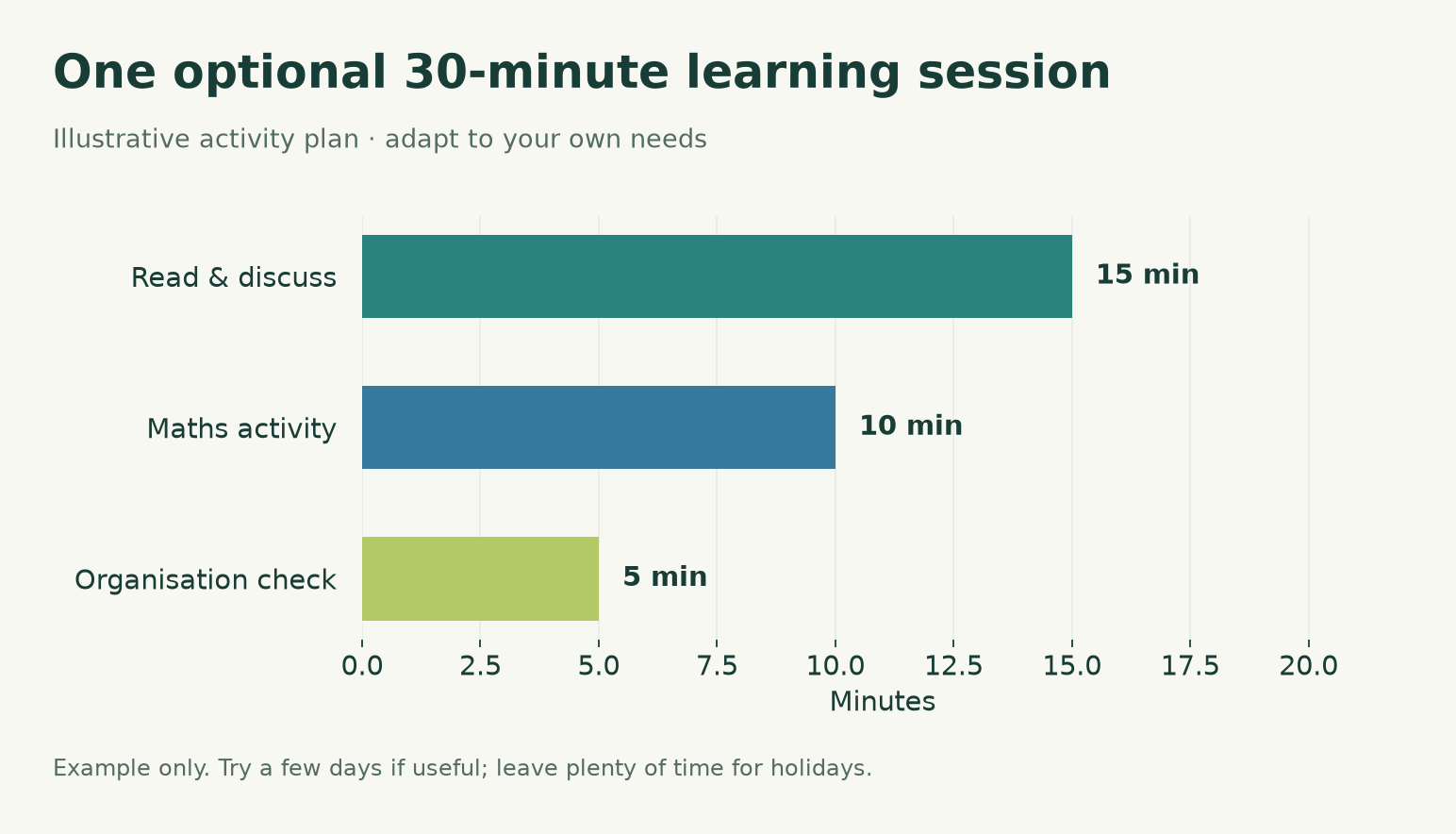
The graph below shows one optional 30-minute activity session: 15 minutes of reading, 10 minutes of maths and a 5-minute organisation check. You might try it on two or three days in a week, reduce it, or skip it during travel. These are planning examples, not a required study allocation or a prediction of progress.
Choose one clear outcome per activity. “Read a chapter and explain why the character changed their mind” gives a child a purpose. “Do more English” does not tell them where to begin.
4. Strengthen reading and paragraph writing
Offer a choice of novels, nonfiction, articles or graphic novels. After reading, ask your child to summarise the main idea, point to a detail that supports it and explain an unfamiliar word using the surrounding sentence. Keep it conversational; every reading session does not need a worksheet.
For a short writing activity, ask, “Should our school have a longer lunch break?” Write one paragraph with a clear opinion, a reason, an example and a closing sentence. Read it aloud together. Revise one thing, such as an unclear sentence or missing explanation, instead of correcting every spelling error at once.
5. Check useful maths foundations with everyday examples
Use a few questions to find the next teaching step. Ask your child to explain a method, draw a model and check whether the answer is reasonable. A correct answer with no explanation may need a follow-up question; an incorrect answer can show exactly what to practise.
- Fractions: which is larger, 2/3 or 3/4? Use equal-sized wholes or a number line.
- Percentages: a $60 item has 25% off. What is the saving and the new price?
- Decimals: place 0.6 and 0.45 on a number line. Which is closer to 1?
- Measurement: a recipe uses 3/4 of a cup. How much is needed for a double batch?
- Reasoning: a trip starts at 8:35 am and lasts 45 minutes. When does it finish?
Answers: 3/4 is larger; the saving is $15 and the price is $45; 0.6 is closer to 1; a double batch needs 1 1/2 cups; the trip finishes at 9:20 am. If a question is difficult, choose that one skill to revisit with help.
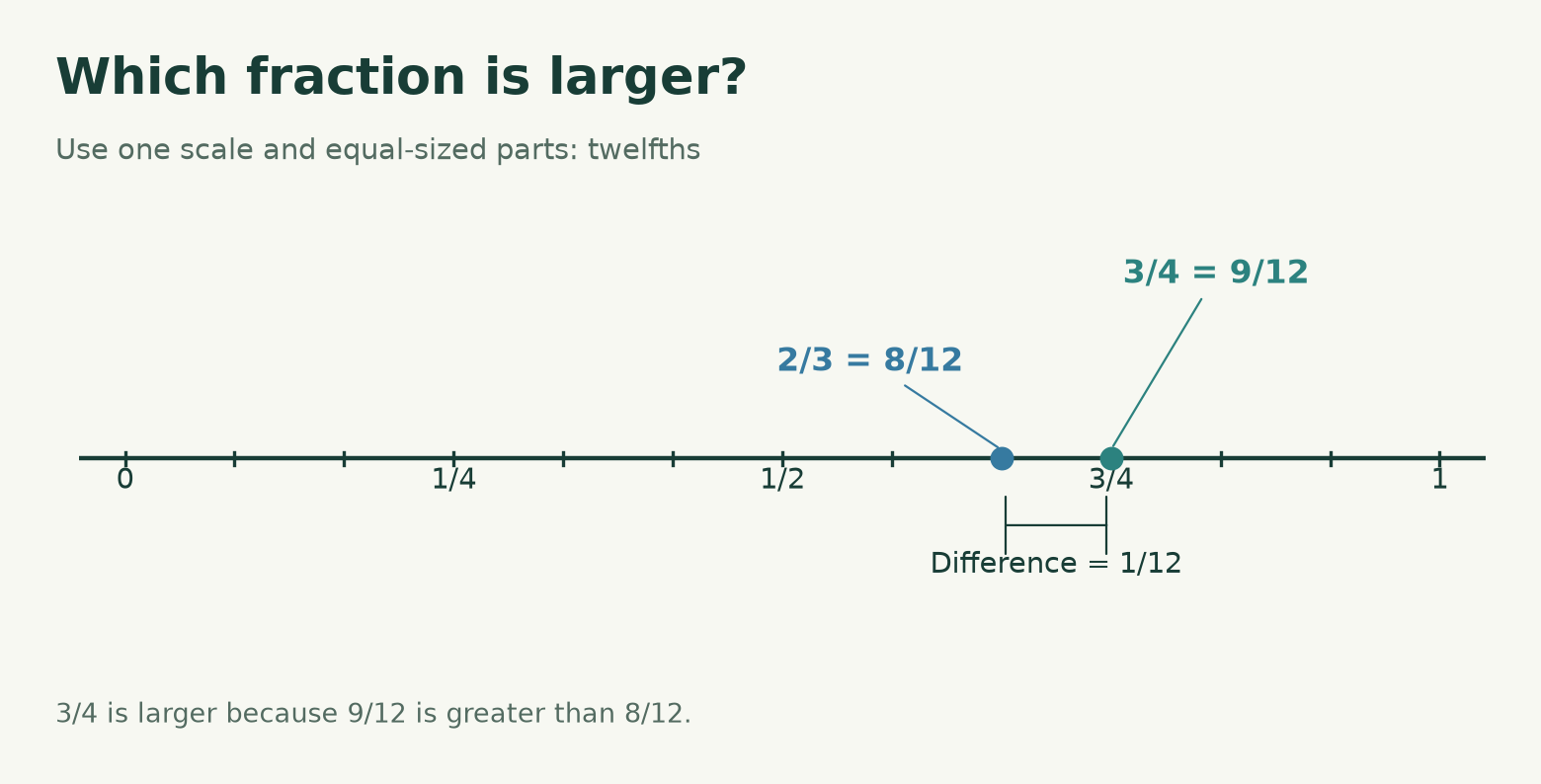
In the graph, both fractions sit on the same scale from 0 to 1. Expressing them in twelfths gives 2/3 = 8/12 and 3/4 = 9/12. The gap is 1/12. Ask your child to explain why the denominator alone cannot tell us which fraction is larger.
6. Talk about friendships and asking for help
Practise a few ordinary sentences: “Can I sit here?”, “Which room are we going to?” and “I understand the first step, but I need help with the next one.” Discuss who your child can approach if they feel lost or have a problem: a classroom teacher, home-group teacher, year-level coordinator or another staff member identified by the school.
Acknowledge worries before trying to solve them. “That sounds unfamiliar; let's work out who can help” gives you a shared next step. Keep checking in once school begins, including what went well and what still feels confusing.
7. Use this final-week checklist
- Confirm the first-day time, meeting place and travel plan.
- Check labels, uniform, books and the school's equipment list.
- Practise school-device access using the school's instructions; keep passwords private.
- Choose one place for timetable, homework and notices.
- Rehearse the evening bag check and a realistic morning routine.
- Write down one staff contact and one question your child wants to ask.
When would extra support help?
Start with your child's Year 6 teacher feedback and speak with the new school about any continuing learning needs. If the same fraction concept, reading task or writing skill remains difficult after explanation and practice, agree on one or two specific priorities. A short list makes school support or tutoring easier to focus.
Super Tutors offers Years 7–10 English, maths and science support in Hawthorn East and live online. Tell us which skill your child wants to strengthen before Year 7. We can discuss a suitable tutor, lesson format, availability and fees. For a lighter plan for the whole family, read A Summer Learning Plan That Still Feels Like a Holiday.